“Embracing the Inevitable: Exploring the Concept of Memento Mori in the Context of Life and Death”

Memento Mori; Remember You Must Die

Reflections on my Mother’s Passing, Doha Airport,  5th May 2024

I have just returned from my second trip to Australia in 3 months..a record for me in my 22 years living in the UK. Sadly the most recent trip coincided with my mum’s death. Three weeks ago I received a call from my sister to say mum’s kidneys were operating at 5% and it was unlikely she would live for much longer. I was on the plane almost immediately but despite my best efforts to  get back in time, she passed whilst I was in transit.

I arrived in Melbourne very late  and so it was not until the following day that my two sister’s and I went to mum’s house to prepare it for the wake and assess things. Upon opening the door and moving through the house, what did I see?

The car keys, sunglasses, a travel card and her gym pass in the bowl on the hallway table.

A neat little pile of paperwork, pens and spectacles on the dining table.

A basket of half finished quilted hexagons next to the armchair in the living room.

Pale View of the Hills by Kazuo Ishiguro, marked at page 83, and a pair of cheap of reading glasses laid on the bed.

A small green ceramic mug with the remaining dregs of a black coffee by the sink.

A red lipstick on the bathroom counter.

Two pairs of trousers and three t shirts in the ironing basket in the  laundry.

An empty bottle of red wine and the weekend newspaper in the recycling pile by the back door

A blue cotton dressing gown hanging on the clothes line, still slightly damp.

This small and poignant series of still lifes /lives touched me deeply and reminded me, yet again of that tenuous, if any, line between life and death. All these objects were still so alive with mum’s day to day life, her personality, her routines and the way she occupied her house. They all assumed she was coming back to them and yet they felt deserted, the dust their function stripped and relegated to no mans land. If mum had known that she wouldn’t be returning would she have washed her mug, ironed and put away her clothes, emptied the recycling into the appropriate bins?

Sadly, these objects were the first things to be cleared away. If I’d thought about it earlier I would have insisted that they be left in their in their place until last or at least photographed them, to savour the last remaining sense of my mother’s physical presence and touch.

Thought for Today

Some of you may have seen a recent post I put out on Facebook and Instagram where I juxtaposed a quote about intestines from Kafka by the Shore by Haruki Murakami with a sculpture I made of the same motif?


I’m so fascinated by the replication and mirroring of forms inside our bodies with those outside in nature and the metaphoric significance of these relationships. It’s something I really only understood after participating in a human dissection workshop and saw inside the human form-; the way cloud formations reflect the striations of fascia along the illiotibial band and spinal column, the mother of pearl luminosity and silkiness of our tendons, the oceanic-like forms of our abdominal viscera, the upside down oak tree of lung, the feathered delicacy of the oblique muscles, the list goes on ad infinitum.
I see and feel reassured by these connections and the understanding that nature and the animal kingdom has an internal equivalent in me and me with it. I am both in awe and take great comfort that we are not separate (from one another or the world around us) but are forever reverberating, resonating and reflecting alongside and in relationship to one another.

Time

Hand Studies (Bridget)

I’ve been spending the past four days taking photos of these mannequin hands, copying Bridget Fiske’s fine gestures from our rehearsal last week. As with the mannequin dance based on Pena Bausch’s choreography, I am ending up with enough photos so create an animation much longer than the work I’m citing. In this process (and the birds and seascape paintings) I attempt to elongate time, stretch and tease it out, dissect it, give it added attention…. I do the same when I am working therapeutically with clients, stretching tissue, opening space for better communication between physiological systems.

Deborah Hay my body the buddhist

A beautiful observation from Hay from a group dance class where there were a couple of accidents with candles being knocked over rand then the subsequent clean up by all the dancers…..

“When I knocked over the candle I thought ”I my god,” but then I thought, ”Oh good. We all get to come together again”

This is perhaps one of the silver linings to what seems a never ending deluge of bad news.

A counter-intuitive approach

Retard: delay or hold back in terms of progress or development. From the French retarder, Latin, retardare from re-‘back’ and tardus-‘slow’.

I was thinking about my new project today, the seascape film, and what it is I am trying to achieve with this work. As with all my practice, there is is an allegiance to the first impression, but in addition, an exploration of non-narrative time. The word retard came to mind and I was struck by this idea of delaying or holding back the tide of progress and development in order to create a qualitatively different space or path.

As part of this, I’ve been practising sitting, doing nothing at all, for 15 minutes a day. The idea is to fully engage with inactivity, to digest and cultivate a sense of, and feeling for, what can be best described as no mans land. What are the qualities of this territory and how are they different to the dimensions of endless consumption, action, movement, opinion, subjectivism and infinite perspectivism we currently impose on the past, present and future? It appears counterintuitive to our current way of thinking but my feeling is that there are great creative forces residing in this space and its about having the skills to recognise them.

So…this is what I’ll be exploring with the seascape film, the open horizon-; no mans land, exemplar par excellence.

The diptych and autostereograms

I’ve been thinking about those Magic Eye images that were so popular in the 90’s and the kind of vision that is required to see the hidden motifs within the patterns. It’s all about diverging one’s vision so that each eye sees separately. Our natural tendency is to allow the brain to converge this double vision into one unified picture. It took me to Cezanne who, interestingly, was painting at the time this optical research was taking place. His paintings seem to exemplify this distinctive vision, of a world seen from two slightly different angles. This is what makes his paintings seem like they are teetering on the edge of an abyss, objects and landscapes and people on the verge of falling, neither flat nor full of volume but both and neither at the same time.
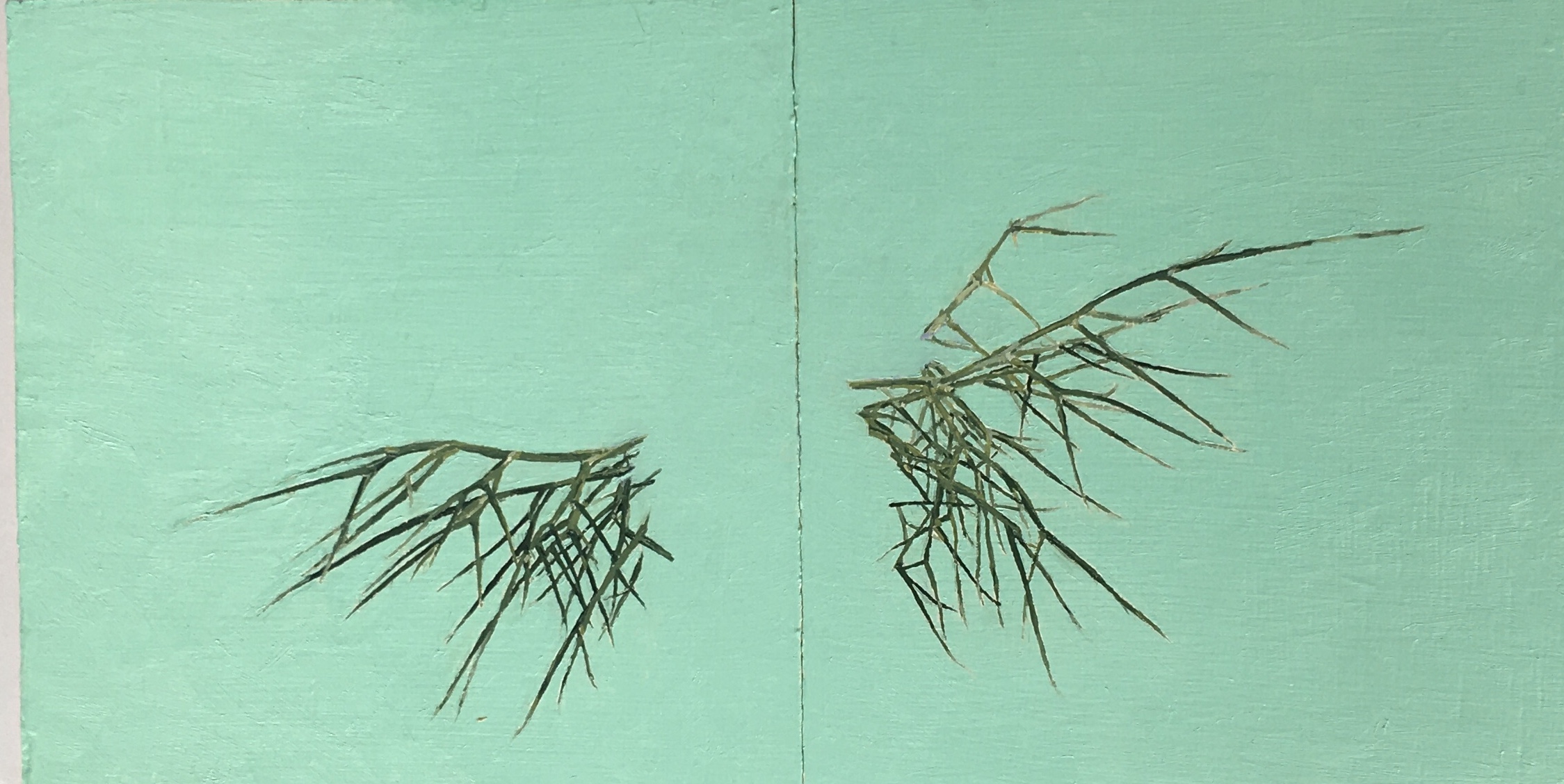
It took me to my own preoccupation with the diptych and how I’m drawn to making images that disrupt the tendency of our eyes to settle in one direction. I like the idea that one can create an image where the cerebral and visual faculties are not subsumed into one another but rather, are in dialogue. Sometimes, the conversation between the two is conflicting, other times more harmonious.

Learning to Paint

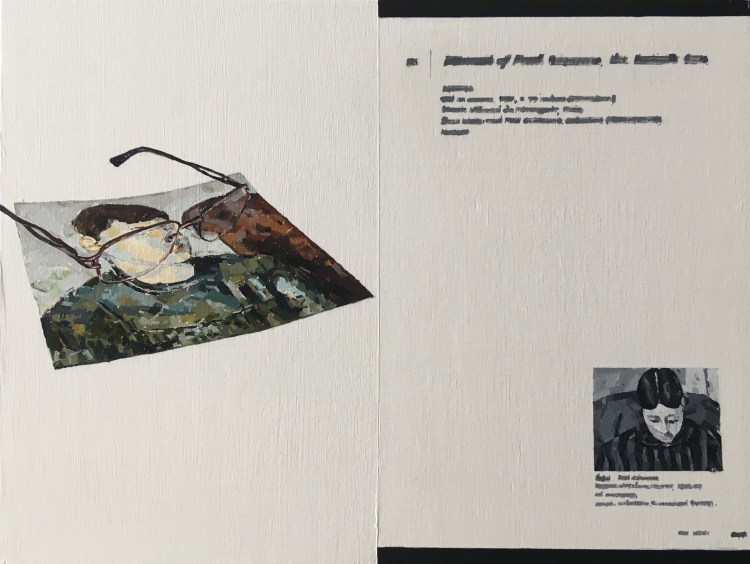
Still Life with Spectacles. oil on board 22 x 30cm 2020

At some level it feels like every painting is about learning how to paint (again) Like any profession it’s about developing skills and putting those skills to the test. One feels like a beginner every time one starts a new painting. Cezanne’s Portrait of his Son, is my favourite ever painting. In my eyes it’s perfect. So what a pleasure to discover the means with which I could study it ‘into’ a new work. The relationship between form, volume, colour, representation and abstraction in this modest piece is so tightly knit and yet so beautifully fresh.