“I think we can relate to impermanence very viscerally. You don’t need much contemplative practice to start to notice how everything that we feel and think and experience, perceive and so on, is changing, is in motion. And the apparatus that we use to notice impermanence is also in motion, is also impermanent. And that everything we conceive of in our relationship to our insight of impermanence is also impermanent, is also changing.” Michael Stone, I Had to Stop Reading, Best of Awake in the World, Podcast, 4th January, 2025.
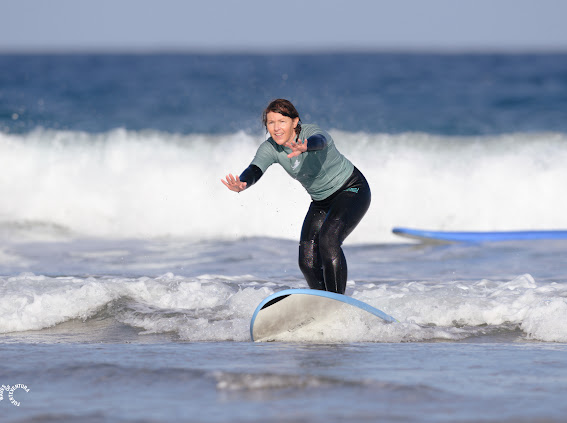
I recently took an art focused sabbatical in Fuerteventura and while I was there decided I’d take some surfing lessons. I’ve always liked the idea of surfing and whilst I am a pretty confident ocean swimmer and body surfing is one of my favourite things to do, I’ve never attempted using a board. I figured it wouldn’t take me too long to get the hang of it; I’ve got good balance, decent reflexes, and can endure being in the surf for long periods. When I booked the lessons, the staff at the surf school reassured me that I’d be up on the board and riding small waves after 2-3 lessons. But you know what? I was ABSOLUTELY rubbish! I had an inkling after the second lesson that this wasn’t for me but I really don’t like to fail so I insisted on attending all seven lessons. I fell A LOT and because we learnt in shallow water, this meant most of my falls were onto hard sand. Over the course of the week I incurred two very bruised toes, the same number of fingers, what felt like a dislocated collarbone (it wasn’t) and on the last day, a sprained ankle.
You see, the thing about surfing is that everything is moving all the time: the sea, the wind, the board, the surfer… and on top of this every wave is different and the conditions for surfing are also constantly changing. So whilst everything works together to create ‘surf’, the configuration of all the different elements alters in each and every moment. This makes it such a difficult sport (for me, at least). All week, the instructors were encouraging me to “stay relaxed”, “to look up and towards the cliffs above the beach”, “to stand up more quickly…but not too quickly” and although I understood the instructions conceptually, sadly (and frustratingly), my body simply refused to comply. I think my longest surf – and I use this term very loosely! – was about 10 seconds. And even then it felt like a happy accident rather than anything resembling progress.
Despite my failings on the surfboard, the experience DID get me thinking about the relationship of movement to groundedness and how nothing is entirely stable, not even the cliffs that I was trying to focus on for balance. Like everything else they too are subject to time, just much slower and not as evident to our naked eyes. It’s something I reflect on a lot in my Sangha meditation group; the knowledge that ALL matter is moving and changing at different speeds and ALL THE TIME!!! Going deeper still, and keeping in mind the Zen Buddhist teacher Michael Stone quote at the beginning of this blog, we see how changeable even our perception is; that what and how we see (or are seen) is dependent on when and where we are positioned at any given moment. So….. basically we live in a world where everything is interdependent but the number of perspectives we have on everything is infinite and infinitely variable. It is dizzying. No wonder we crave stability and security so much (often in the form of possessions and relationships) and why we lean towards facts and statistics …anything to provide us with a sense we are ‘on solid ground’, ‘have a grip on things’, ‘feel settled’ and can ‘see clearly’.
It feels to me that Paul Cézanne, my favourite artist of all time, had a deep and profound understanding of this tension between the need for stability and the reality of impermanence. His paintings reveal to us, whether it be in the form of a bowl of apples, a portrait of his wife or a view of a mountain, a world that is forming before our eyes. The still life, portrait and landscape motifs that he attended to time and time again, appear to be on their way to becoming objects (an ear, a tree, a tablecloth) but the colours, shapes and lines never fully arrive at that definitive outline or a horizon that would to subject them to gravity and set them apart or fix them in space and time.
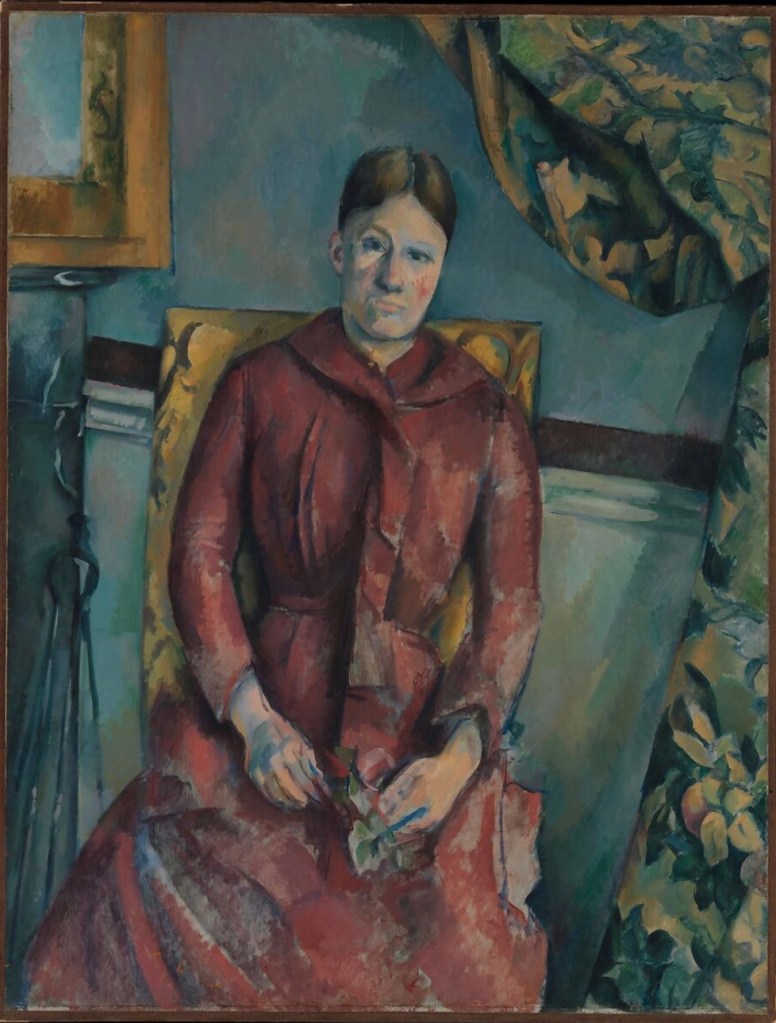
Take for example his portrait of Madame Cézanne from 1888-9. First and foremost it appears that the whole room is tipping to the bottom right and that if it wasn’t for the right-angled frame, or in the top left, the vertical edge of what appears to be a fireplace, the room would collapse and the artist’s wife would slip off her chair. Whilst the direction of light from the right permits us a certain amount of certainty, it is juxtaposed with many other spatial incongruities that defy conventional perspective and gravity. The edging on the wall does not agree with the pitch of the fireplace and frame above it, the curtain sits both in front and behind Madame Cezanne and whilst we understand that she is seated by the inclusion of the back of the chair, her dress is depicted in one plane and she does not appear weighted down into a seated position. A sense of shallow space is created via the use of warm and cool tones but even these refuse to fit into any coherent pattern with that golden window in the top left leaping to the foreground.
So many passages of the painting are in the process of being defined but refuse to do so…left hand becomes dress, dress becomes chair, curtain becomes both still life (bottom right) and landscape (top right). The expression and characteristics on one side of the face become a different expression and has different characteristics on the other side, even to the point of losing an ear. The curtain speaks to us of weight and mass and yet also willingly drifts off into a faraway landscape at the top edge; it is one thing but also another, distinct and at the same time inseparable from the world in which it belongs and from which it was made. This is a painting that is both illusory and real in equal measure, dreamlike and solid.
The work reminds me of something David Whyte wrote in his book Close Consolations: The Solace, Nourishment and Underlying Meaning of Everyday Words:
“Our human essence lies not in arrival, but in being almost there: we are creatures who are on their way, our journey a series of impending anticipated arrivals”
I think this is why Cézanne’s paintings always feel fresh to me, why I never tire of them and return to them time and time again. His understanding of impermanence, inter-being and perception and his ability to render that vision in paint (just before it collapses into the next moment or perspective) nourishes my intellect, sparks my curiosity and inspires my own art practice. Paradoxically, in a world that is ever changing, Cézanne remains my constant companion.
 Laura van Tatenhove